The task of a car park smoke extraction system
A vehicle fire in an enclosed car park quickly fills the space with smoke. The smoke protection system must:
- limit the spread of smoke into adjacent zones and fire compartments;
- give fire brigades access to the seat of the fire from the fresh-air side;
- remove heat and reduce the load on the structures.
How jet fan smoke extraction works
- The fire alarm identifies the fire zone and sends a signal to the control cabinet.
- General ventilation is switched off; the smoke extract fans start first, followed by the supply (Ukrainian State Building Norms DBN V.2.3-15, cl. 8.36).
- The jet fans start according to a pre-calculated scenario for that zone — at the required speed and in the required direction. Reversible fans change the direction of the flow depending on the location of the fire.
- The smoke moves towards the nearest extract shaft, while a fresh-air zone remains on the opposite side for evacuation and for the work of the fire brigade.
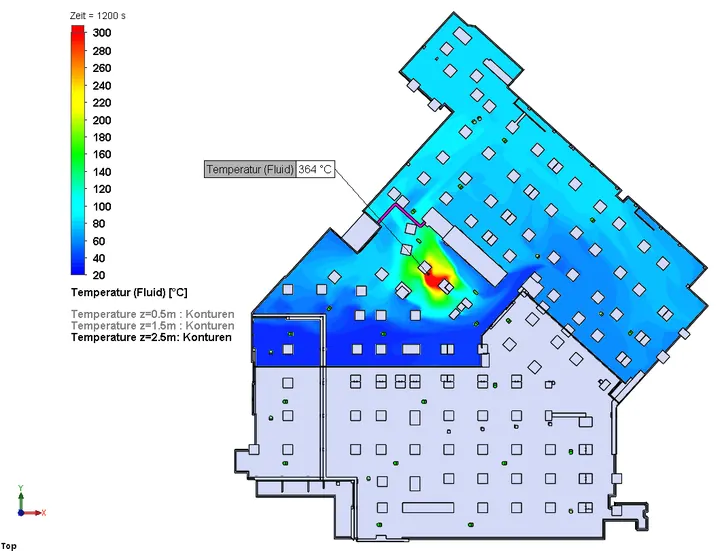
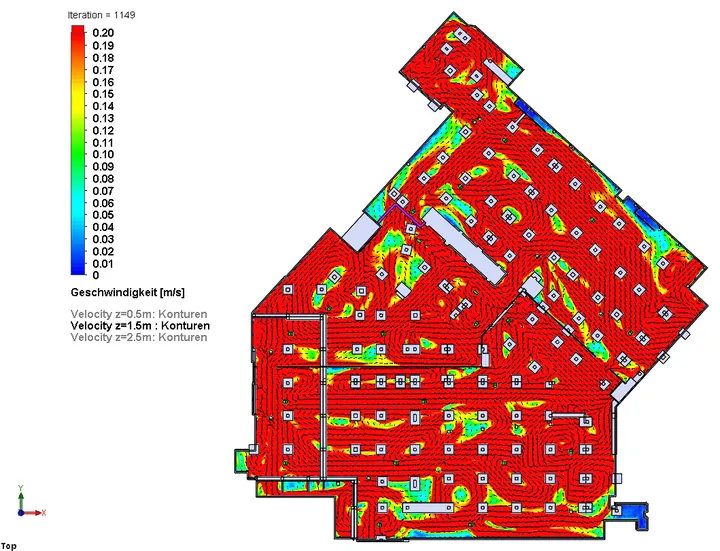
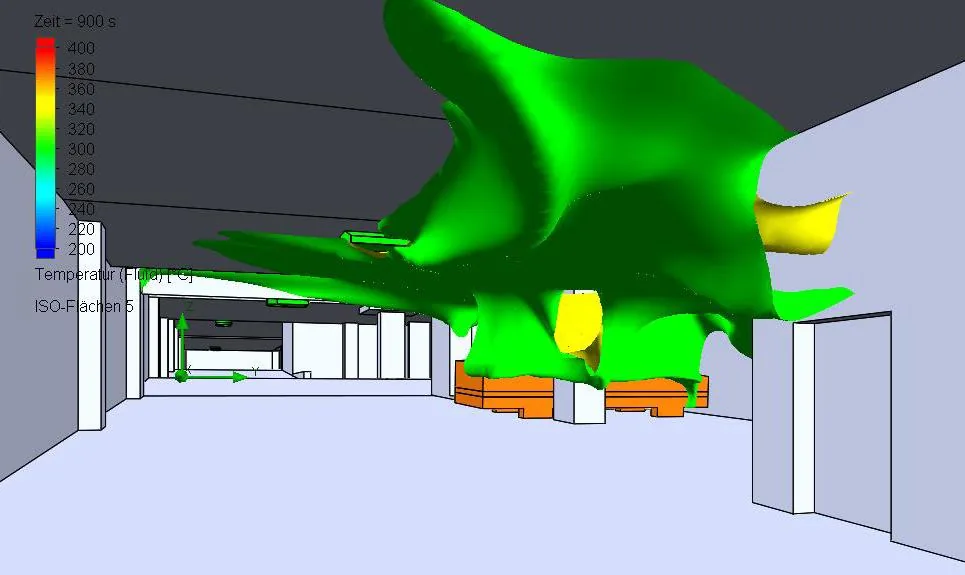
The scenario determines which fans start and when, including whether a start delay is needed near the seat of the fire so as not to stir up the smoke layer during evacuation. Every scenario is checked by CFD modelling.
Standards requirements for car park smoke extraction
| Document, clause | Requirement (abridged) |
|---|---|
| DBN V.2.3-15, cl. 8.33 | Smoke-control ventilation is mandatory for the parking areas of underground and enclosed above-ground garages and for isolated ramps. Jet fan (impulse) smoke extraction systems are permitted for enclosed above-ground garages if their effectiveness is confirmed by calculations |
| DBN V.2.3-15, cl. 8.34 | Mechanical smoke extraction is through shafts; flow rates, the number of shafts and dampers are determined by calculation; in underground garages one smoke inlet device serves no more than 900 m² |
| DBN V.2.3-15, cl. 8.36 | In a fire, general ventilation is switched off; exhaust smoke-control ventilation starts before the supply |
| DBN V.2.3-15, cl. 8.37 | Automatic, remote and manual start of the systems |
| DBN V.2.3-15, cl. 8.43 | Power supply of smoke-control ventilation systems and CO sensors — under reliability category I |
| DBN V.2.5-56, cl. 10.7.2 | Fans of mechanical smoke and heat extraction systems must be of a design conforming to EN 12101-3 |
The full list of documents and the dates they came into force is on the page standards for car park ventilation and smoke extraction.
Underground car parks: how a jet fan system is justified
The direct permission in cl. 8.33 of DBN V.2.3-15 applies to enclosed above-ground garages. For underground car parks the norm does not mention jet fan (impulse) smoke extraction directly, so in practice such a solution is justified by calculation — usually by CFD modelling of the fire — and approved in the established procedure, followed by the design expert review.
Since 1 August 2026, the Ukrainian national standard DSTU CEN/TS 12101-11:2026 has been in force — the first national document dealing with mechanical smoke and heat exhaust systems with horizontal airflow in enclosed car parks. It gives designers and reviewers a common methodological basis for such solutions.
The justification route for a specific project is determined by the general design engineer; we prepare the calculations, the CFD report and the technical data of the equipment for it.
Fans for car park smoke extraction
| Installation location | Wolter equipment | Fire resistance |
|---|---|---|
| Parking area | JFUO/JFRO, JFUC/JFRC jet fans | F300, F400 (120 min) |
| Parking area with low headroom | JFC radial jet fans | F300; F400 on request |
| Extract shafts | AXV/BXV axial fans | F300 (60 and 120 min), F400 (120 min) |
| Extract shafts with redundancy | AXG two-stage fans | F300 / F400 on request |
| Roof | RVHT roof fans | 400 °C, 120 min |
Along with the fans, the cable lines, switches and controls must also remain operational in fire mode. Wolter high-temperature safety switches have been tested to EN 12101-3 together with a jet fan. For more, see Wolter smoke exhaust fans.