What jet fan ventilation is
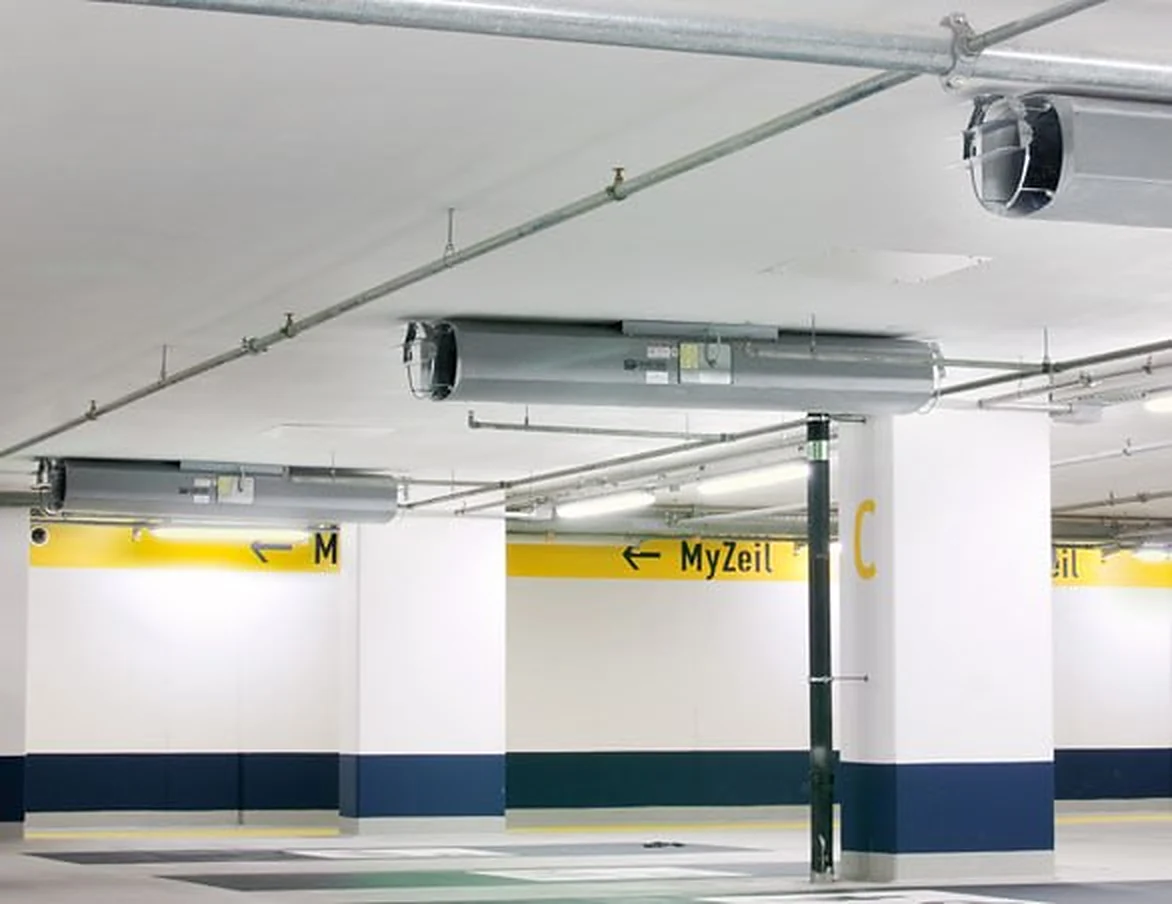
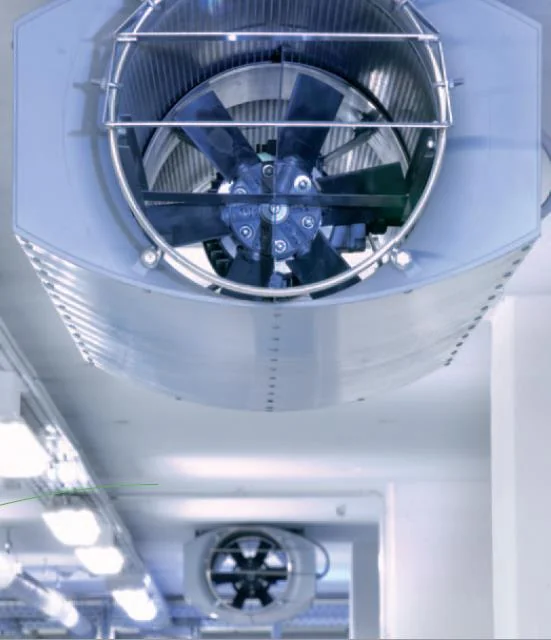
Jet fan, or impulse, ventilation is a system in which air in a space is moved not by ducts but by free jets. A jet fan discharges air at high velocity; the jet entrains the surrounding air and passes its momentum on to it. Several fans placed according to the calculation form a controlled airflow in the car park, from the supply points to the extract shafts.
The shafts and the supply and extract fans remain, but a branched network of ducts under the ceiling is no longer needed. That is why jet fan systems are most often used in underground and enclosed above-ground car parks of residential complexes, shopping centres and office centres: ventilating covered car parks without ducts gives more headroom and simpler installation.
How the system works
- Supply. Outdoor air enters through supply shafts with fans or through open openings and ramps.
- Jet fans. Placed under the ceiling, they drive the airflow through the whole car park and leave no stagnant zones.
- Extract. Axial fans in the extract shafts remove polluted air and, in a fire, smoke and hot gases.
- Sensors and controls. CO-controlled car park ventilation works automatically: CO sensors and the fire alarm send signals to the control cabinet; the controller switches on the required fans at the required speed and in the required direction.
Two modes: everyday ventilation and smoke extraction
| Everyday mode | Fire mode | |
|---|---|---|
| Start signal | CO sensors, operating schedule | fire alarm |
| Purpose | dilute exhaust gases to permissible concentrations | remove smoke and heat, maintain visibility on escape routes and access for firefighters |
| Fan operation | low speed, and only where needed | full speed according to the scenario for the specific fire zone |
| General ventilation | operates | switched off; the extract starts before the supply (Ukrainian State Building Norms DBN V.2.3-15, cl. 8.36) |
Energy consumption is determined by the everyday mode: most of the time the fans are stopped or run at low speed, and full power is used only in a fire. For more on the fire mode, see the page on car park smoke extraction.
Jet fan or ducted ventilation
| Criterion | Jet fan system | Ducted system |
|---|---|---|
| Ducts in the parking area | not required | a branched network under the ceiling |
| Space under the ceiling | free: easier to place lighting, sprinklers and cable trays | ducts take up headroom and cross other services |
| Installation | fans are fixed to the ceiling on brackets | installation and sealing of ducts, fire protection of transit sections |
| Maintenance | access to every fan; in Wolter JFUO/JFRO the motor unit slides out of the casing | inspection and cleaning of ducts |
| Fire mode | controlled flow; reversible fans change direction depending on the location of the fire | smoke is removed through the smoke inlet devices of the network |
| Justification | calculation and CFD modelling | aerodynamic calculation of the network |
For car parks with a complex layout and limited height, a jet fan system is usually more compact, and its operation can be verified by modelling before construction. The final decision is made by the design engineer on the basis of the calculation.
What the standards require
In brief, as of October 2026:
- DBN V.2.3-15:2007 “Car parks and garages for passenger cars” (Ukrainian State Building Norms, with Amendments No. 1–3):
- enclosed garages are fitted with supply and extract ventilation designed to dilute harmful emissions to permissible concentrations; in underground garages, separate systems for each floor (cl. 8.29);
- enclosed garages are fitted with CO monitoring devices with an alarm in a room staffed around the clock and automatic switching on of ventilation (cl. 8.31);
- smoke-control ventilation is mandatory for the parking areas of underground and enclosed above-ground garages; jet fan (impulse) smoke extraction systems are permitted for enclosed above-ground garages provided their effectiveness is confirmed by calculations (cl. 8.33);
- in a fire, general ventilation is switched off and exhaust smoke-control ventilation starts before the supply (cl. 8.36).
- DBN V.2.5-56:2014 “Fire protection systems” (with Amendments No. 1–2): fans of mechanical smoke extraction systems must be of a design conforming to EN 12101-3 (cl. 10.7.2).
- DSTU CEN/TS 12101-11:2026 — the Ukrainian national standard specifically for smoke and heat exhaust systems with horizontal airflow in enclosed car parks; in force since 1 August 2026.
The full table of clauses with links to the official texts is on the page standards for car park ventilation and smoke extraction.
How we design jet fan ventilation
- Input data. Floor plans and sections, ceiling structure and beam height, number of parking spaces, positions of shafts, ramps and fire compartments.
- Air exchange calculation. We determine the supply and extract flow rates for the everyday mode and for smoke extraction.
- Fan layout. We select the type and number of Wolter jet fans, taking into account the beams, the height and the noise requirements.
- CFD modelling. We check the velocity and temperature fields and the spread of smoke for the design fire scenarios — more about CFD.
- Controls. Control algorithm: zones, scenarios, switch-on sequence, interaction with the fire alarm.
- Specification and supply. Wolter equipment with technical documentation, to the construction schedule.
Equipment
- Wolter jet fans JFUO/JFRO, JFUC/JFRC and JFC — thrust up to 104 N, classes F300 and F400.
- Wolter smoke exhaust fans — axial AXV/BXV and two-stage AXG for extract and supply shafts.
- CO sensors, smoke detectors and a control cabinet with a programmable controller: Wolter supplies the system as a complete package so that all the elements work as one.
Where our systems operate
Jet fan ventilation systems and Wolter equipment have been used at more than 20 projects in Ukraine — including the car parks of the GREAT, White Lines, OK’LAND and Taryan Towers residential complexes, the Respublika Park, Retroville and Blockbuster Mall shopping centres, and the UNIT.City innovation park. All projects.