Wolter · 3 series
Roof fans
A roof fan extracts air straight through the roof, with no plant room in the loft or on a technical floor. Wolter offers three lines: the general-purpose RH/RV/RVS, the RVH for hot and contaminated air and the RVHT for smoke exhaust.
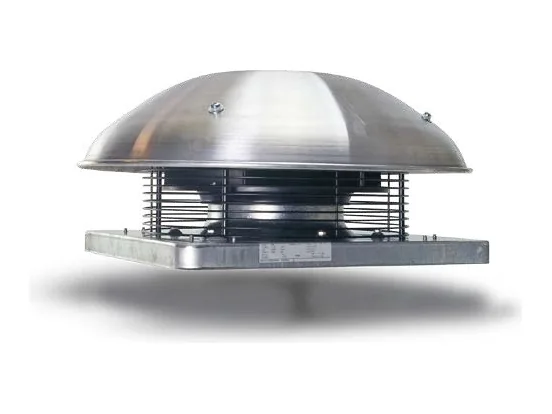
Wolter roof fans are centrifugal: a backward-curved impeller draws air from the shaft or duct and discharges it above the roof. The fan sits on a roof socket through which the exhaust duct passes.
- RH / RV / RVS — external-rotor motor in the airstream; horizontal (RH) or vertical (RV) discharge, RVS with an attenuator hood. Sizes 190–710.
- RVH — vertical discharge, IEC motor outside the airstream; for air up to 120 °C. Sizes 355–900.
- RVHT — for smoke exhaust through the roof: motor outside the airstream, 400 °C for 120 minutes. Sizes 355–710.
Series
Wolter roof fan series
RVHT — roof smoke exhaust fans
Roof fan for smoke exhaust through the roof: motor outside the airstream, 400 °C for 120 minutes, sizes 355–710.
RH / RV / RVS — centrifugal roof fans
Roof fans with a backward-curved impeller on an external-rotor motor: horizontal (RH) or vertical (RV, RVS) discharge, sizes 190–710.
RVH — roof fans for hot air
Vertical-discharge roof fan with the IEC motor out of the airstream: air up to 120 °C, sizes 355–900.
Series comparison
| Series | Type | Airflow, m³/h | Pressure, Pa | Temperature rating |
|---|---|---|---|---|
| RVHT | roof smoke exhaust fan, 400 °C | — | — | 400 °C, 120 min |
| RH / RV / RVS | centrifugal roof fan | — | — | — |
| RVH | roof fan with motor out of the airstream, up to 120 °C | — | — | up to 120 °C |
Choosing a series
| Task | Series |
|---|---|
| General extract of lightly contaminated air | RH — horizontal discharge |
| Extract of more heavily contaminated air | RV — vertical discharge; RVS where noise matters |
| Warm, contaminated air from kitchens and processes | RVH — up to 120 °C |
| Smoke exhaust through the roof | RVHT — 400 °C, 120 min |
Installation
The fans sit on Wolter roof sockets for flat and pitched roofs. An SD socket silencer is available to reduce duct noise, and the range also includes roof hoods without an impeller (LH/LV).
Power supply and speed control
RH/RV/RVS come with single-phase (230 V) or three-phase (400 V) multi-speed motors and are speed-controllable. RVH can be transformer-controlled up to size 500; with speed-controlled motors the permissible air temperature is up to 80 °C.
Applications
Where they are used
Malls, offices and hotels
Roof, centrifugal, duct and cabinet fans for retail, office and hotel buildings.
Learn moreSmoke exhaust and smoke control
F300/F400 smoke exhaust fans to EN 12101-3 for car parks, malls, atria and plant rooms, with design and CFD.
Learn moreResidential complex ventilation
One supplier for all ventilation in a residential complex: Wolter car-park jet fans plus Himpel apartment ERVs and fans.
Learn moreIndustrial ventilation
Axial and centrifugal fans for workshops, chemical-resistant plastic fans, versions for hot air and explosive atmospheres.
Learn moreFAQ
Frequently asked questions
Can RVH be used for smoke exhaust?
No. RVH is designed for air up to 120 °C and is not tested to EN 12101-3. For smoke exhaust through the roof you need RVHT — 400 °C for 120 minutes.
What is the difference between RH and RV?
The discharge direction: RH discharges horizontally, RV vertically upwards. The manufacturer recommends RH for lightly contaminated air and RV for more heavily contaminated air.
Is there a silencer for a roof fan?
Yes. The fan sits on a Wolter roof socket for a flat or pitched roof, and an SD silencer can be built into the socket. Where noise on the roof matters, choose RVS — an RV with an attenuator hood.
Need equipment selection or a system design?
Send us the layouts or the brief — we will prepare a selection, a calculation and a quotation.