Why car parks need ventilation
An enclosed car park has two different ventilation tasks:
- Daily ventilation. Vehicles emit carbon monoxide (CO), nitrogen oxides and other pollutants. The system must keep concentrations below permitted limits while the load varies strongly through the day — morning and evening peaks, quiet nights.
- Fire mode. When a car catches fire, smoke and hot gases spread quickly under the slab. The smoke control system must remove smoke and support evacuation and fire-fighting access.
The traditional solution is a network of exhaust and supply ducts with grilles. It takes height, is expensive to install and ventilates dead zones poorly. A jet-fan system handles both tasks differently.
How a jet-fan system works
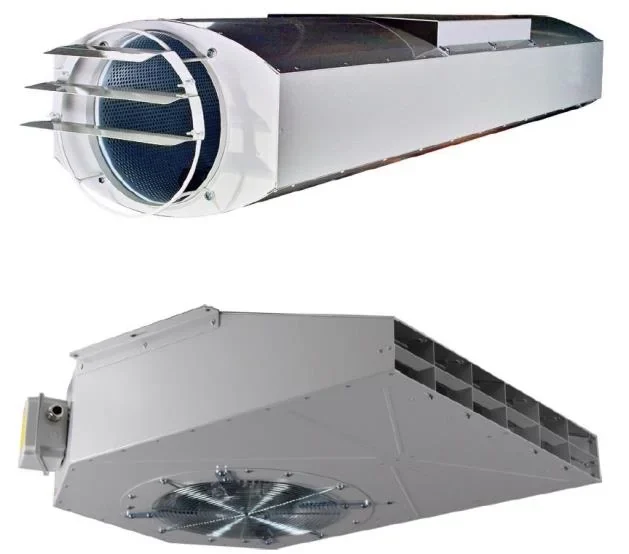
Jet fans are installed under the slab at calculated positions. Each produces a high-velocity jet that entrains the surrounding air, creating a directed flow along the car park from the supply openings (ramps, supply shafts) to the exhaust shafts with axial fans.
- In normal operation the fans run at low speed or start on signals from CO sensors. Energy use is minimal: the system runs only when and where it is needed.
- In fire mode the fans switch to high speed according to a defined scenario. Smoke is driven towards the exhaust, while a smoke-free zone is kept on the fire-fighters’ approach side.
Benefits for developers and design engineers
- Height savings. Without main ducts, car park levels can be lower. On deep multi-level car parks this noticeably cuts excavation and construction cost.
- Less installation. Instead of hundreds of metres of ductwork — a few dozen fans on brackets and cabling.
- Better air distribution. The directed flow leaves none of the dead zones typical of grille systems.
- Flexibility. The layout can follow changes to the floor plan, and reversible fans can change the flow direction depending on where the fire is.
- Energy efficiency. Two-speed motors and CO control reduce time at full power.
What the system includes
- Wolter jet fans — JFUO/JFRO, JFUC/JFRC or JFC depending on headroom and thrust;
- axial exhaust (and, where required, supply) fans rated F300/F400;
- dampers, grilles and silencers;
- CO (and, where required, NO₂) sensors and fire detectors;
- a PLC control cabinet integrated with the fire alarm and building management systems.
How we design
- Input review: plans, sections, beams, ramps, shafts, evacuation scenarios and local code requirements.
- Air-change calculation for daily ventilation and smoke control parameters for fire mode.
- Preliminary layout of jet and exhaust fans.
- CFD modelling of smoke and CO spread — checking visibility, temperature and velocities for each fire scenario.
- Schedule and control logic for the automation.
- Design-review support, supply, installation supervision, commissioning and testing.
Codes and design review
Car park ventilation and smoke control requirements are set by the building and fire codes of the country of construction, and they differ between Kazakhstan, Uzbekistan, Kyrgyzstan and Tajikistan. We follow the local codes and use recognised international references for jet-fan design methodology (for example, the British code of practice BS 7346-7 and the German guideline VDI 2053). See the country pages and the knowledge base for details.
Electric vehicles
Electric vehicles are spreading across the region, and battery fires last longer and are harder to extinguish. That argues for spare thrust, the F400 class and design decisions backed by modelling — we discuss these points at concept stage.