Wolter · 3 series
Jet fans for car parks
Wolter jet (impulse) fans move air and smoke through a car park without branch ductwork. The same fans provide CO-controlled ventilation in normal operation and smoke clearance in a fire.
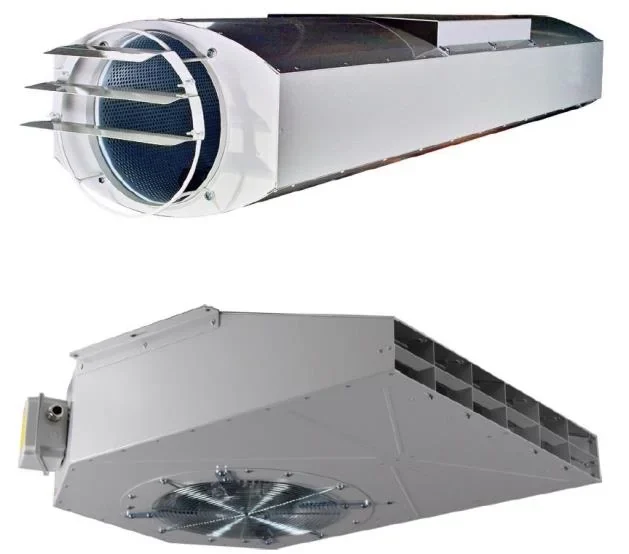
A jet fan produces a high-velocity jet that entrains the surrounding air. Several fans, positioned under the slab according to a calculation, create a stable flow from the supply openings to the exhaust shaft. Instead of a duct network the car park only needs compact fans, which saves storey height and simplifies installation.
Wolter builds three jet-fan types:
- JFUO / JFRO — axial fans in a low oval casing with integrated silencers, for car parks with limited headroom.
- JFUC / JFRC — axial fans in a 1,800 mm round casing, with the highest axial thrust in the range, up to 85 N.
- JFC — centrifugal fans from 221 mm high with an adjustable outlet deflector, for the lowest ceilings and for blowing under downstand beams.
U in the type code means uni-directional, R fully reversible. Reversible fans can change the flow direction depending on where the fire is.
Series
Wolter jet fan series
JFUO / JFRO — low-height jet fans
Axial jet fan in a low oval casing, 343–415 mm high; uni-directional (U) or reversible (R).
JFUC / JFRC — round jet fans
Axial jet fan in a 1,800 mm round casing with silencer: thrust up to 85 N, reversible version available.
JFC — low-height centrifugal jet fans
Jet fan with a centrifugal impeller and nozzle: from 221 mm high, thrust up to 104 N, adjustable deflector.
Series comparison
| Series | Type | Airflow, m³/h | Pressure, Pa | Temperature rating |
|---|---|---|---|---|
| JFUO / JFRO | low-height axial jet fan | 2,448–9,504 | — | F300 (300 °C, 120 min), F400 (400 °C, 120 min) |
| JFUC / JFRC | round axial jet fan | 1,800–11,016 | — | F300 (300 °C, 120 min), F400 (400 °C, 120 min) |
| JFC | low-height centrifugal jet fan | 2,664–10,656 | — | F300 (300 °C, 120 min); F400 on request |
Fire rating and certification
Wolter jet fans are tested to the European standard EN 12101-3 (smoke and heat control systems — powered smoke and heat exhaust ventilators) and are available in:
- F300 — operation at 300 °C for 120 minutes;
- F400 — operation at 400 °C for 120 minutes.
CE marking is under the EU Construction Products Regulation 305/2011, with production supervised by the notified body MPA Braunschweig. The casing-mounted isolator switch is tested together with the fan.
How jet fans are selected
The number and positions of fans come from a calculation and, for smoke control, usually from CFD modelling. It takes into account:
- car park geometry, headroom and downstand beams;
- airflow and location of supply and exhaust shafts;
- design fire size and evacuation scenarios;
- velocity and visibility criteria in the local codes.
We prepare a preliminary layout from the drawings within 1–2 business days and confirm the final arrangement by modelling.
Controls
Each fan is controlled individually from a PLC control cabinet. In normal operation the fans run at low speed according to CO sensors; in fire mode they follow the logic defined by the smoke control scenario.
Applications
Where they are used
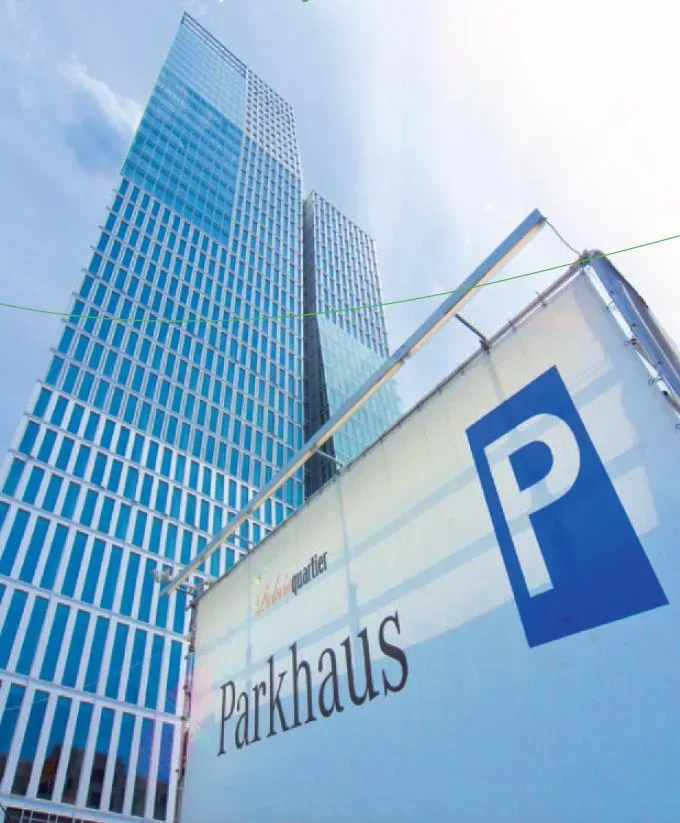
Car park ventilation and smoke control
Jet-fan systems for underground and enclosed car parks: CO-controlled ventilation and fire smoke control without ductwork.
Learn moreSmoke exhaust and smoke control
F300/F400 smoke exhaust fans to EN 12101-3 for car parks, malls, atria and plant rooms, with design and CFD.
Learn moreRoad tunnel and metro ventilation
Tunnel jet fans and axial fans up to F400 for longitudinal ventilation of road tunnels and metro facilities.
Learn moreFAQ
Frequently asked questions
How many jet fans does a car park need?
That comes from the calculation: it depends on area, geometry, headroom, shaft positions and fire scenarios. Send us the layouts for a preliminary estimate — we will prepare a layout and confirm it with CFD modelling.
What is the difference between JFUO and JFRO?
JFUO blows in one direction; JFRO is fully reversible, with guide vanes on both ends so it can run either way. Reversing is useful when the smoke exhaust direction depends on the fire location.
Should I choose F300 or F400?
The class is set by the local codes and the design. Underground car parks often require 400 °C for 2 hours, but the final decision follows the design and the design-review requirements.
Need equipment selection or a system design?
Send us the layouts or the brief — we will prepare a selection, a calculation and a quotation.