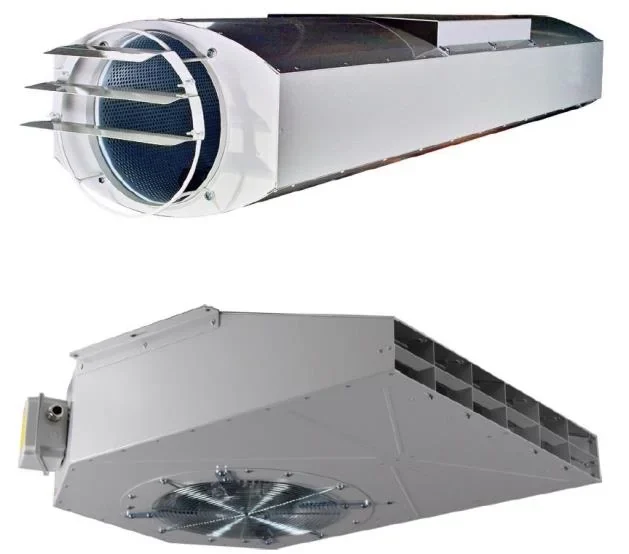
Tunnel ventilation concepts
Road tunnels use longitudinal, transverse and semi-transverse ventilation. Medium-length tunnels most often use longitudinal ventilation: groups of jet fans under the crown drive the flow from portal to portal. Fresh air enters through one portal, and polluted air leaves through the other or through exhaust shafts.
Longitudinal ventilation needs no ducts in the tunnel lining, reduces civil works and makes it easy to add capacity.
Requirements for tunnel fans
- fire resistance — operation at high temperature for a defined time (Wolter tunnel fans up to class F400);
- reversibility — the ability to change flow direction quickly to drive smoke away from people;
- corrosion resistance — tunnel air is aggressive (exhaust gases, de-icing salts, washing); versions with enhanced protection and stainless steel are available;
- secure mounting and vibration resistance — especially in seismic zones.
Wolter equipment for tunnels
- tunnel jet fans — uni-directional and reversible;
- large axial fans for portals and ventilation shafts — sizes up to 2800;
- AXV axial fans for ancillary rooms, running tunnels and stations.
Tunnels in Central Asia
The region is building and refurbishing mountain road tunnels, extending metro systems and building interchanges with underground sections. Such projects need equipment that copes with wide temperature ranges, seismic-rated supports and easy maintenance access.
Our approach
Tunnel ventilation is always designed individually. We join at concept stage: we help select equipment to the designer’s aerodynamic calculation, provide data for modelling and organise supply and installation supervision.